
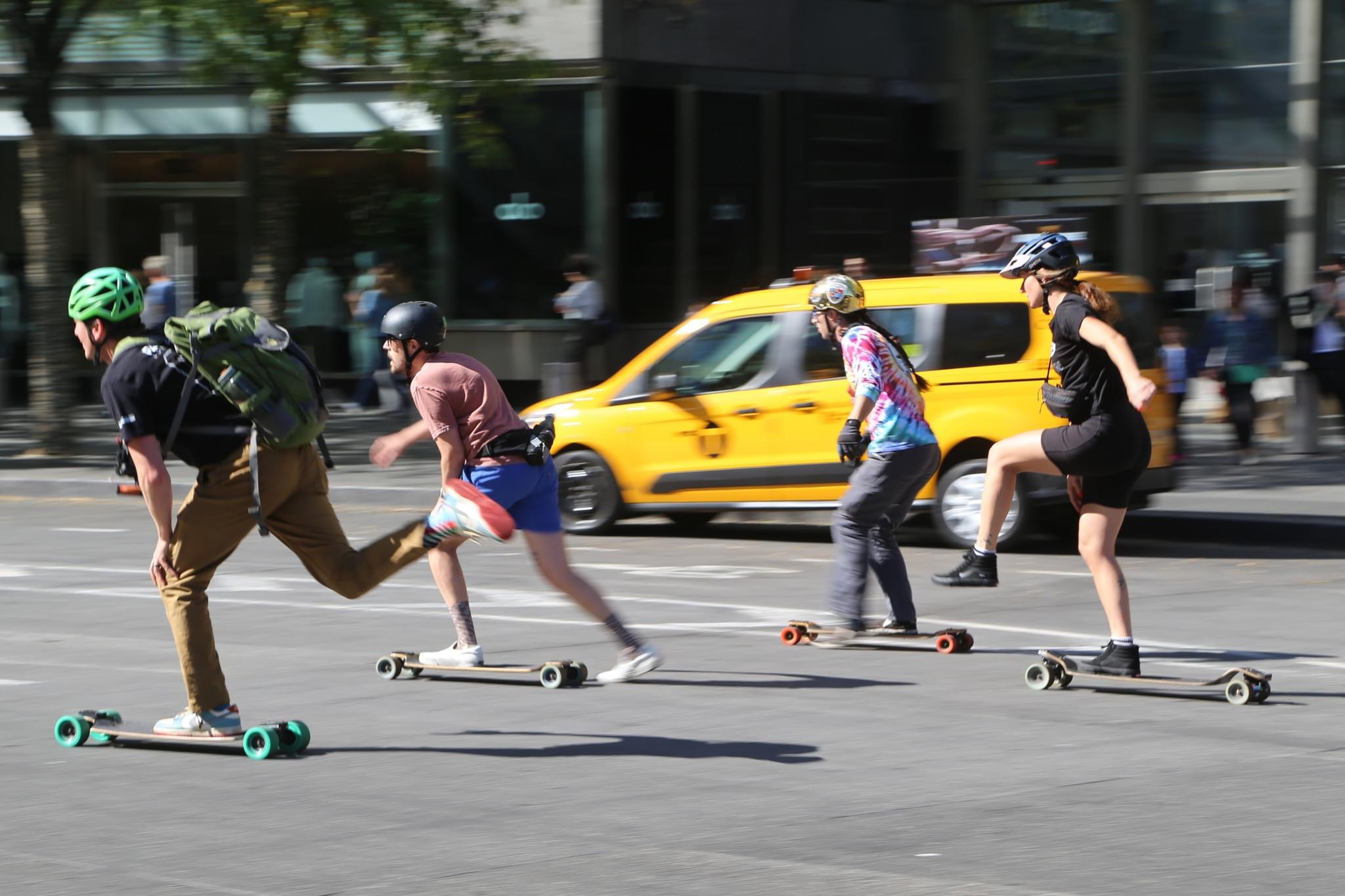
The most common email I get starts with some version of ‘I want to get into longboarding — which board should I buy?’ Finding the best longboard for beginners is simpler than most people think. But before I tell you which board, I need to ask you one thing first:
How do you picture yourself riding?
Not what you think you should want. Not what looks coolest in a video. How do you actually picture yourself using this board day to day? That answer tells me almost everything I need to know.
Quick picks: the best longboard for beginners, by how you’ll ride
| If you mostly want to… | Start with | Why |
|---|---|---|
| Cruise, commute, or get back into skating on mostly flat ground | Pranayama | Sits super low for easy pushing and a stable ride, and it’s ready to go out of the box. Our most popular board. |
| Do the same, but you live near hills | Trip | The same platform as the Pranayama, set up with RKP trucks for more grip and stability at speed. |
| Pump and ride long distances | Superdupersonic | Built to turn your body’s movement into speed, with a very low, stable ride. |
| Learn to slide and freeride | Nexus | Low, stiff and made for control at speed. |
| Skate playfully around town on something short | LowTide, Fantail or Banantheon | Kicktail cruisers with a short, snappy wheelbase. |
| Ride as a bigger or taller rider (250+ lb or about 6’3″+) | Quest (or Nexus above about 280 lb) | More platform and more structural headroom. The Quest is rated to about 280 lb, the Nexus to about 350 lb. |
Not sure? Browse all longboards, or email me how you picture yourself riding and your weight, and I’ll tell you exactly what to get.
A Note on Price
Pantheon boards aren’t cheap, and I want to be upfront about that.
My first board was a Moose complete I bought off eBay for $70 in 2006. The first board I ever rode was my friend’s Sector 9 pintail. Those experiences were stepping stones, and I had a lot of fun on them. If I were the broke college student-athlete I once was, I’d probably start the same way — get something affordable, see if it sticks, upgrade later. These days, I’d probably be searching Facebook marketplace if I were in that position.
But a lot of people buy a cheap board and it never really takes. Not because they didn’t like skating, but because the gear got in the way before they found out how awesome it could be.
If you’re an adult with a budget and you’re serious about this, I’d encourage the buy-once-cry-once approach. What you’re getting from Pantheon is purpose-built design — every deck, every wheel core, every mold is custom designed by Pantheon. We don’t make generic boards that do everything okay. We make specialized boards that do specific things exceptionally well. Most of what I’d recommend as the best longboard for beginners are actually excellent commuter and distance boards, because low boards with big wheels are extremely easy to start with. Footbraking is easier, balancing is easier, running over pebbles is easier. The best thing about these decks is that they are both the easiest to start on and they also grow with you as you progress. You may get into downhill and freeride, but you’ll always have a top of the line, useful commuter deck.
The one exception on custom product: our bearings are generic. Good ones, but just a high quality factory bearing with our name on them. Same as most bearings, with very few exceptions. I don’t believe expensive bearings are worth the premium, and no bearing has ever beaten a better tuck down the hill. Bearing marketing annoys me, personally. But I’m willing to be wrong…it’s just that I’m not. Ride your bearings. Beat them up. Replace them. Expensive bearings can still rust, and you don’t want a puddle to keep you from getting out there!
If Pantheon is out of your budget right now, that’s okay. Start somewhere, fall in love with the sport, and come back when you’re ready. We’ll be here.
The Returning Rider
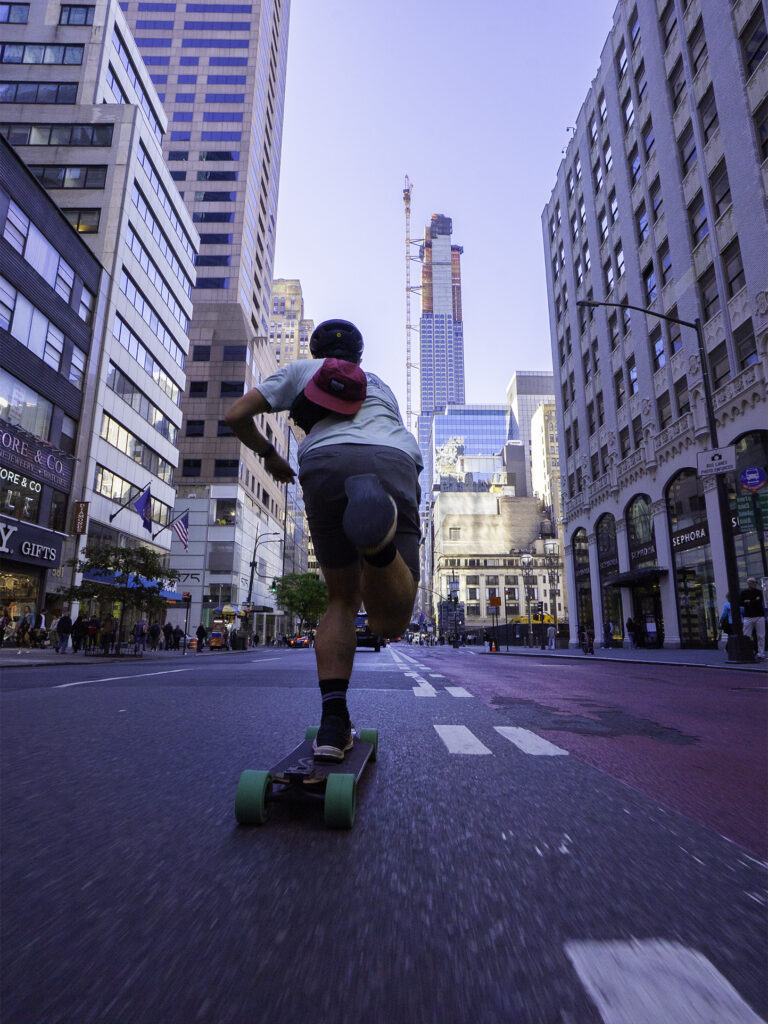
This is the most common person I talk to. You skated when you were younger — street skating, maybe some transition — and now you’re older, your knees tell you you’re older, and you want something you can cruise around the neighborhood on without feeling like you’re going to eat pavement every five minutes. You’re not exactly a beginner. The muscle memory is in there somewhere, and you just need to find it. You just want to feel alive on wheels.
You want the Pranayama. It’s my personal favorite board and our most popular deck for a reason. It’s what we call a double drop setup, meaning it sits super low to the ground, which makes pushing easy and the ride stable. An excellent purpose built board for beginners and advanced riders alike. One of the fun things about this board is that we set it up with street trucks—our very own that we designed specifically for this board. You get street truck geometry with full size barrel/barrel longboard bushings. The turn is progressive — it starts subtle and increases as you lean, which feels natural and confidence-inspiring while also being alive at any speed. It comes ready to ride and doesn’t require any setup tweaking to feel good right out of the box. Usually the stock bushings on the Pranayama work for just about any rider. My son at 13 years old under 100 lbs rides the same setup that I do at 195 lbs. We can get more into bushings later.
If you picture yourself cruising the neighborhood, commuting, or just getting some exercise on flat ground, this is your board.
What if you live near hills?
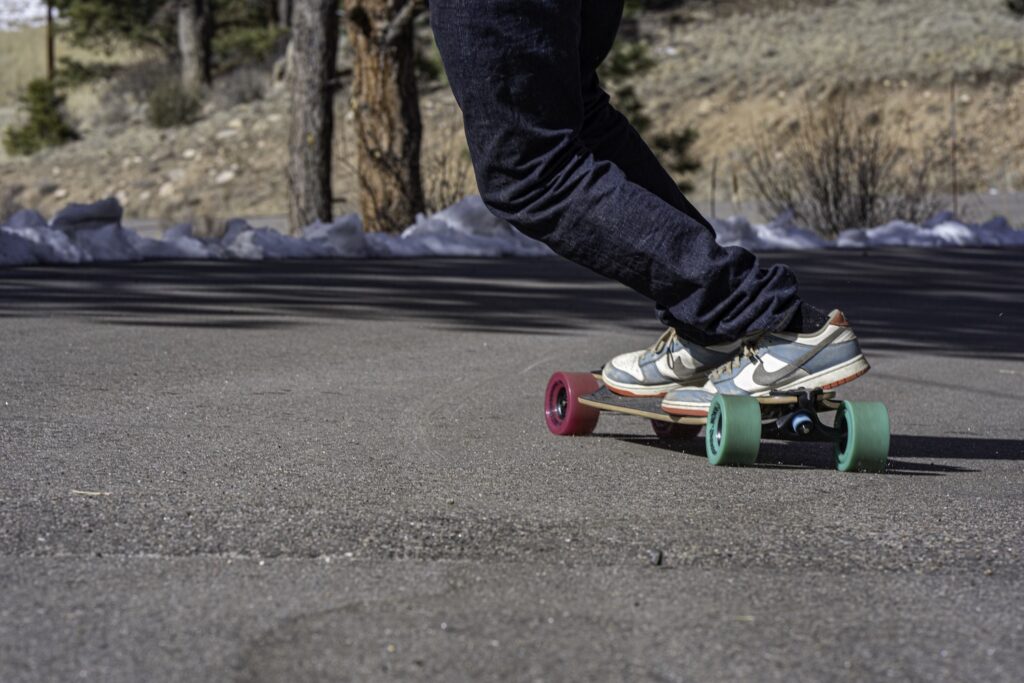
Are you a returning rider and you live near some rolling hills? You may want to move over to the Trip deck. This is literally the exact same platform as the Pranayama, but the ends of the board are built with the clearance of RKP trucks in mind, and that’s how you’re going to set this one up. RKP trucks are your standard “longboard truck,” and they’re both more reactive and also more stable at speed. The turn style is linear, and the center is usually more defined. This truck style provides a little more grip. We describe the RKP vs TKP truck feeling to be a little more “on rails.” It’s a little less flowy feeling on one foot (pushing stance) and a little more serious (better for carving and speed management). As stated, the trucks provide more grip, which equates to being able to stick a turn when you’re carving out speed, and they provide more feedback in a slide, which leads to more control. The ride height is a touch taller on RKP trucks, and between this and the center feeling on one foot, this is why I tend toward suggesting the Pranayama for many beginners who are riding mostly flats. The flow feeling can’t be duplicated any other way. But for someone who wants to ride a weapon that is also a push deck, they’re going to lean toward the Trip.
The Rider Who Wants to Pump
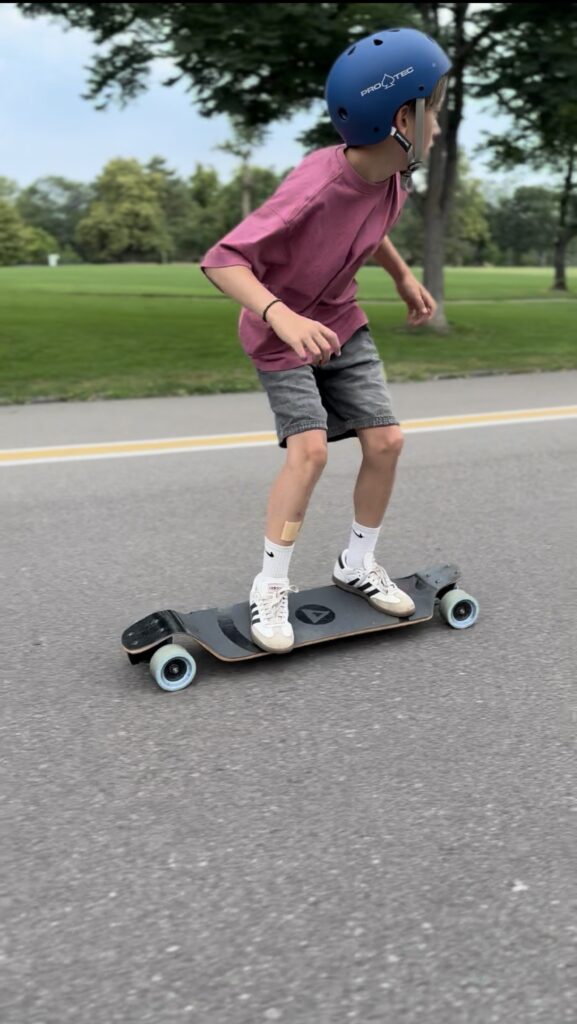
Pumping is generating speed from your body rather than pushing with your foot. It’s efficient, addictive, and genuinely great exercise. If you’ve watched videos of people snaking down a path without ever putting a foot down and thought “I want to do that” — you’re a pumper at heart.
The Superdupersonic is built for this. It’s our dedicated long distance pumping board. The geometry is designed specifically to convert your body’s movement into forward momentum. It’s front-heavy in its steering, which is different from anything you’ve ridden before, but that’s what makes it pump so efficiently. Many serious distance riders are already riding the Superdupersonic. The ride height is very low, which makes it an efficient pusher, and many riders find comfort in the stable back end. This makes the Super quite stable at speed, while also providing a platform to push off of when throwing your weight around and pumping. For this reason, even if you’re a beginner and you just thrive off of the idea of stability, the Superdupersonic can be a great choice. The key to the Superduper is the setup, and you’ll want to dive into those details on the Superdupersonic page, and of course you can always email us with setup questions to help us get you dialed in just right. Pro tip: when reaching out, include your intended riding conditions, your preference toward liveliness or stability, and your weight. That’ll save you an extra email and we can jump straight into the nitty gritty.
The Parent Riding with Kids
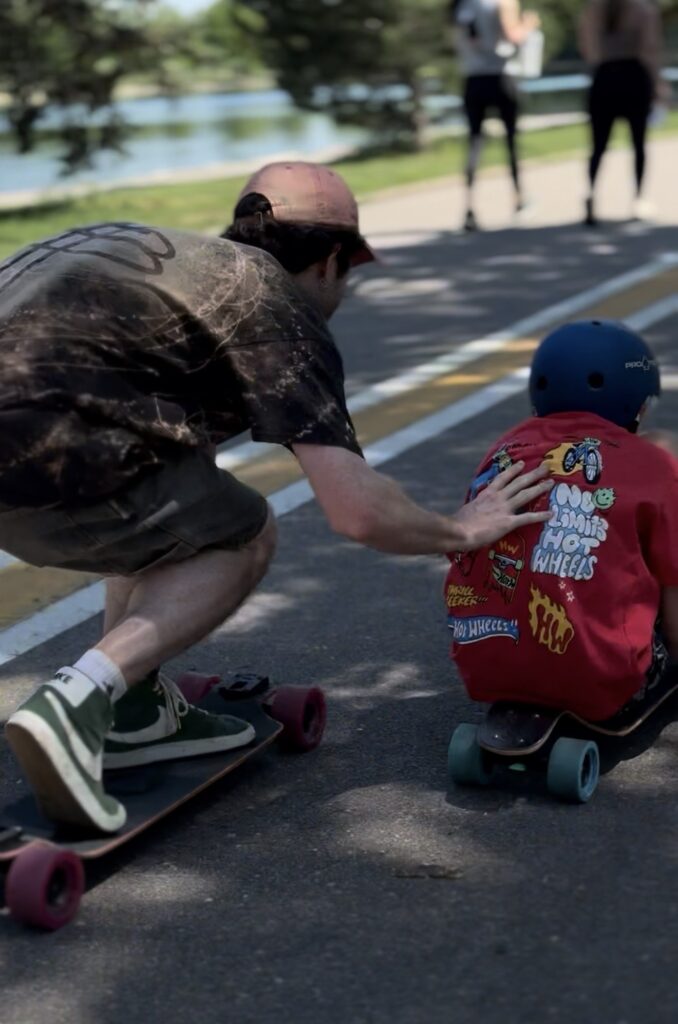
You got your kid a board. Now they’re dragging you along. You want something you can keep up on without it being a whole thing.
Same answer as the returning rider — Pranayama. It’s easy to learn on, stable enough that you’re not white-knuckling it, and an overall excellent ride that is super easy to start on and one you won’t outgrow once you get more comfortable. A lot of parents end up loving longboarding even more than their kids do, and doing it on proper gear is a good way to really enjoy that transition.
One thing of note, and I hear this a lot. Many parents get a Pranayama, and their kids steal it from them. Of course, this is the ideal—that everyone gets a perfect ride that they’re really stoked about. Just a heads up!
The Rider Who Wants to Learn to Slide
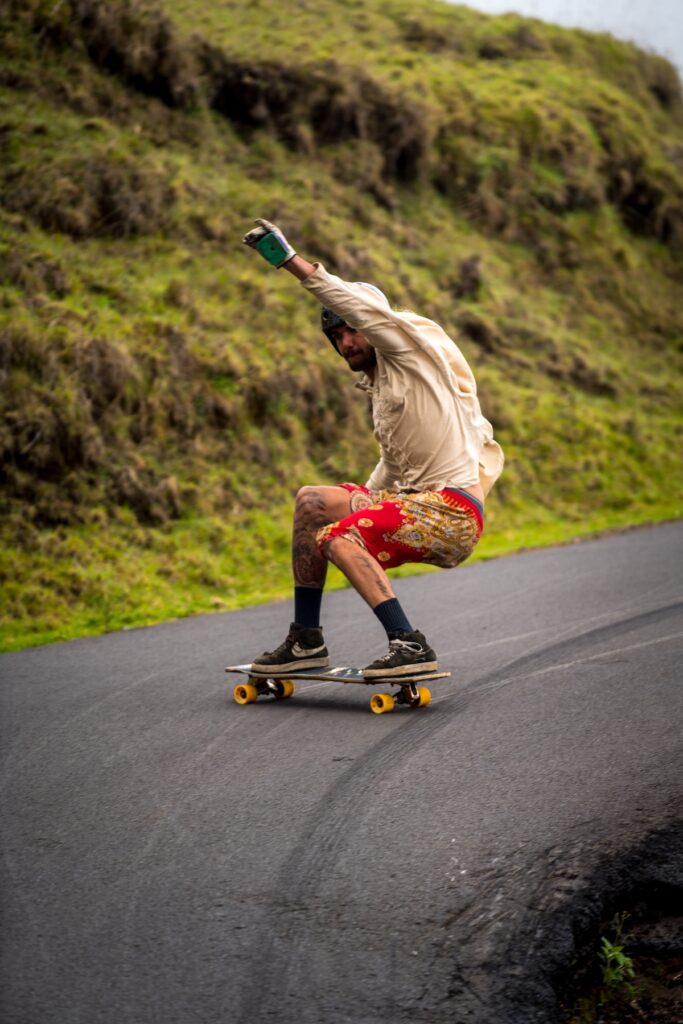
This is where we go a different direction. Sliding requires a different kind of setup — you need to be able to break traction intentionally and control it. That means a board with wheel wells or enough clearance, wheels that release predictably, and a setup that’s responsive enough to initiate a slide but stable enough to control it.
The Nexus and the freeride-oriented boards in our lineup are built for this. If sliding is your goal, tell me that upfront and we’ll build you the right setup. You can absolutely slide on a commuter setup, but there is a big difference between throwing a little check slide for speed control and throwing out a long slide for style points. Make sure you distinguish this with me when you’re asking questions, because that can easily be the difference between recommending a Trip, a Nexus, or a dedicated downhill/freeride board, and it’ll affect what wheels we choose, too! Another fun way to slide is on a cruiser deck. A dedicated kicktail board can be very playful for everyday skating, and because you’re putting your feet practically on top of the trucks, having a little flex in the middle won’t affect playful slides too much. The short wheelbase can make things extra snappy, and standing on top of the trucks allows for very clear weight transfer between the front and the rear truck. And weight transfer, my friends, is everything. If this sounds like your type of ride, you’ll want to look between the Banantheon, the Lowtide Cruiser, or the Fantail Cruiser.
For Heavy Weight Riders
If you’re north of 220-250 lbs, a couple of things matter more: deck flex and wheelbase stability. A deck that’s tuned for a 160 lb rider can feel mushy or under-supported if you’re significantly heavier. It could even be potentially unsafe, as an overweighted deck can break more easily.
That’s why several of our most popular decks come in heavy flex versions. The Pranayama Portal Heavy Flex, the Trip Whale Heavy, and the Quest are all built with stiffer layups specifically for bigger riders — same geometry and ride characteristics you’d expect from these boards, just tuned so the deck doesn’t blow out under more weight.
Generally speaking, I usually recommend the Pranayama or Trip heavy flexes for riders over 200 pounds and up to about 250 pounds. At 200, you CAN ride the standard construction, but I think it’s important to express here that the newest construction on the Pranayama Portal, Trip Whale, and Nexus has been our most durable construction ever. I trust it to recommend to these riders, and for someone just over 250, you can probably get away with one if you feel you would benefit from the smaller platforms and wheelbases of the Trip and Pranayama. The truth is, we haven’t seen one broken yet, and the data points aren’t there for me to know exactly where this board peaks out. I’m doing my best to make our best recommendation. It’s been out for a while now, so no breaks is a great data point!
If you’re over 250 or if you’re very tall (let’s arbitrarily say around 6 ft 3+, although this is really more about your comfort in a small stance than your specific size), I’m usually recommending the Quest to riders who are truly looking for a board to just get around on, riding for exercise or commute. The Quest is still a slim board and it’s got about 2 more inches in the platform length than the Prana and Trip. Because it’s slim, it’s as well suited for ergonomic pushing as our other push decks, since every time you strike that push foot to the ground, it will be closer to your center of gravity, and therefore you will not be affecting your center as much as a wider board would for each push. This is a small but meaningful difference from other low boards you may see out there that are often equipped with 180mm trucks. Slimmer trucks, slimmer wheels…this is all part of the formula that makes a Pantheon a Pantheon.
For the heaviest riders — we’re talking over about 280 lb — the Nexus is worth a look. Normally a deck we recommend for freeride and downhill incorporated into your commute, the Nexus has the most structural headroom in our lineup and holds up well under serious weight without sacrificing feel. It is a little wider, so a little less ergonomic for pushing super long distances, but we still pair it with 165mm trucks so it’s slimmer than the “classic” 180mm drop through design. You can still make our 92mm Karma wheels fit quite well on this board. Just know that this deck is not a deep carve board. The board has been cut to maximize control, because you need control at speed, so it’s designed to get your feet as close to the wheels as possible, which means you’ve got plenty of clearance for natural turns that happen during commuting, but you’ll need to run smaller wheels if you want to really loosen those trucks a bunch for deep leaning carves.
As always — tell us your weight when you order. It’s the single most useful piece of information for getting your bushings, truck angles, and deck choice all dialed in together.
What Almost Everyone Gets Wrong: Bushings
Here’s the thing nobody tells you, and it’s the most common reason a new rider has a bad first experience with a quality longboard.
Bushings are the urethane cushions inside your trucks that control how the board turns. Most people either stick with whatever comes stock on Paris trucks (sloppy, undersized bushings that can cause over-articulation and ultimately wheelbite) or they go to various extremes and grab the softest or hardest bushings they can find because they think “soft = easy to turn” or “hard = stability.”
Both approaches get it wrong.
The relationship between bushing hardness and how a board turns isn’t just about softness or hardness — it’s about leverage. Your weight, the height of your setup, and the angle of your trucks all affect how much force you’re applying to the bushing. A lighter rider on a high-angle truck needs a softer bushing than a heavier rider on the same setup. A heavier rider on a low-angle truck might need an even harder bushing than you’d expect because of the increased leverage of the geometry.
When you order a complete from us, tell me your weight and expected riding conditions. That single piece of information lets me set you up with truck angles and bushings that will make the board feel exactly right — responsive without being twitchy, stable without being stiff. It’s the difference between a board that clicks immediately and one that feels off when it arrives and you’re reaching back out to find out how to get it right. Which is fine by the way!
The Short Version
There is no single “best longboard for beginners.” It doesn’t exist. What is the best for you will depend on how you want to ride your skateboard.
- Want to cruise, commute, or get back into skating? → Pranayama or Trip
- Want to pump long distances? → Superdupersonic
- Want to learn slides and freeride? → Nexus, maybe a cruiser, or talk to me
- Not sure? → Tell me how you picture yourself riding and your weight, and I’ll tell you exactly what to get.
Every board we make is purpose-built for something specific. The goal isn’t to sell you the most expensive option — it’s to get you on the right board so you actually love riding it.
Want our top pick for every riding style, not just beginners? See Best Longboards of 2026.
Shop the Pranayama See all longboards
Jeff Vyain has been designing purpose-built longboards since 2014. Every mold, every shape, every wheel core — all custom, all designed in-house. He co-holds the world record for the longboard marathon and still answers his own customer emails.
Beginner Longboard FAQ
What is the best longboard for beginners?
It depends on how you want to ride. For most adult beginners who want to cruise, commute or get back into skating on flat ground, I recommend the Pantheon Pranayama. If you live near hills, go with the Trip. For pumping long distances, the Superdupersonic. For learning to slide, the Nexus.
Are low, double-drop longboards good for beginners?
Yes. Low boards with big wheels are the easiest to start on: footbraking is easier, balancing is easier, and rolling over pebbles is easier. They also grow with you as you progress.
What longboard should a heavier beginner get?
For riders roughly 200 to 250 lb, I usually recommend the heavy flex versions of the Pranayama or Trip. Over 250 lb, or if you’re very tall, the Quest, which we rate to about 280 lb. Above that, the Nexus has the most structural headroom in our lineup, rated to about 350 lb.
Should a beginner start with a cheap longboard?
If you’re on a tight budget, starting with something affordable is fine. A lot of people buy a cheap board and it never takes, though, because the gear gets in the way. If you’re an adult with a budget and you’re serious about it, I’d buy once and cry once.
Do beginners need expensive bearings?
No. Good factory bearings are plenty. Ride them, beat them up and replace them when needed.
What bushings should a beginner use?
The right bushing depends on your weight, your setup height and your truck angle, not just soft versus hard. Tell us your weight and riding conditions when you order a complete and we’ll set up your bushings and truck angles to match.
I really found this helpful. I have been talking to Dave from based board’s on what setup I need to look for to skateboard across America for charity . this really help answer alot of questions. tho I still have a few more.